Somewhere in Hampshire there is an operations manager who has not slept properly since July. Farnborough International Airshow 2026 has just published its final numbers, and the headline is the sort of thing that gets screenshotted into a board deck: 141,580 trade and public visitors, a 41% jump on the previous edition, and more than $84.7 billion in commercial deals signed across five days. The marketing team will be dining out on that until 2028. The registration team will be quietly updating a spreadsheet called LANES_v4_FINAL.
Growth is the goal, obviously. But a 41% attendance increase in a single edition is not a gentle upward trend. It is a step change, and step changes land squarely on the people running the gates.
What Farnborough actually reported
According to Event Industry News, the show gathered attendees from 136 countries across government, manufacturing, investment, academia, start-ups and media. Boeing, Airbus, Embraer, LEAP and Pratt & Whitney led the commercial announcements, while BAE Systems, MBDA and Anduril Industries handled the defence side. The trade press confirmed the same top line: Aerospace Manufacturing reported the 41% surge and the 141,580 figure independently.
The deal book behind that footfall: 353 firm commercial aircraft orders and 904 firm engine orders. Vertical Aerospace also completed the first public electric vertical take-off and landing flight at the show, switching from helicopter mode to aeroplane mode and back, which is either a glimpse of the future or the world's most expensive transformer toy, depending on your mood.
| Metric | Farnborough 2026 |
|---|---|
| Total visitors | 141,580 trade and public |
| Show-on-show growth | 41% |
| Countries represented | 136 |
| Commercial deal value | Over $84.7 billion |
| Firm aircraft orders | 353 |
| Firm engine orders | 904 |
| Show length | Five days |
| Next edition | 17-21 July 2028 |
One detail buried in the press release deserves more attention than it got. Pioneers of Tomorrow, the dedicated careers and STEM day that opened the site to the public on Friday 24 July, sold out ahead of the event. Not on the day. Ahead of it.
What 41% growth really means for trade show ticketing
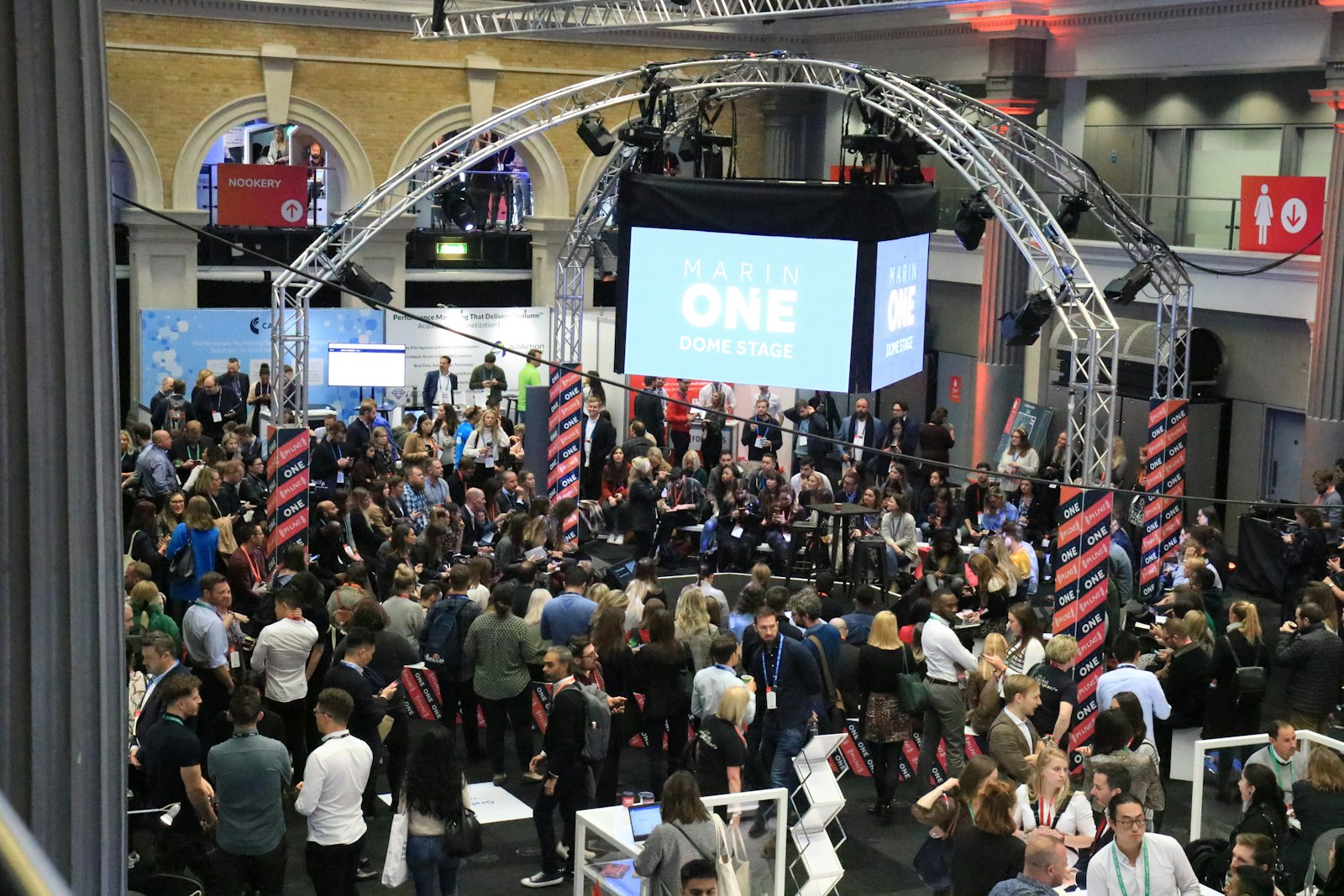
Here is the arithmetic nobody puts in the post-show report. Spread 141,580 people across five days and you get roughly 28,300 a day. Now apply the pattern every trade show organiser knows in their bones: attendance is not spread evenly across opening hours. Say a third of a 28,000-person day arrives in the first ninety minutes, chasing the keynote and the free coffee. That is about 9,300 people, or 104 arrivals a minute.
A check-in scanner that clears one person every ten seconds does six a minute. To hold that line steady, without it growing, you need roughly seventeen lanes running flat out. Add one badge printer jam, one attendee who booked under a maiden name, one exhibitor coach arriving late, and the queue stops being a queue and starts being a news story.
Attendance growth is a marketing metric right up until the moment it becomes a throughput problem, and nobody sends a press release about that.
The uncomfortable part is that the previous edition, at roughly 100,000 visitors by the same maths, would have been sized correctly with about twelve lanes. Twelve lanes and seventeen lanes are not the same operation. They are different staffing rotas, different hardware orders, different floor plans and, in most venues, a different entrance layout entirely. If your registration and check-in platform only tells you how many tickets you sold, you are planning next year's door with last year's blueprint.
Tired of Fee Announcements? Go Flat
eventcloud charges one subscription with no per-ticket fees, so platform news stops being budget news.
Three things separate shows that absorb a growth spike from shows that get eaten by one. First, scanning that works offline, because venue Wi-Fi is always strongest when the hall is empty. Second, badge printing that runs at the gate rather than from a pre-printed alphabetical pile that assumes everyone turns up in the right order. Third, live arrival data by hour, so you can move staff to the north entrance while the north entrance is still salvageable.
The bit the press releases skip: biennial shows are flying blind
Farnborough runs every two years. That biennial rhythm creates a planning problem that annual shows never face, and it explains a lot about why growth spikes hurt so much.
When your event runs annually, last year's arrival curve is a reasonable guide to this year's. When it runs every two years, you are forecasting from data that is 24 months old, gathered under different economic conditions, with a different exhibitor list and a partly different audience. Farnborough's own comparison makes the point: 2026's total was described as nearly double 2022's. Two editions, one doubling. No annual show would ever be asked to plan against a baseline that stale.
Which is why the Pioneers of Tomorrow sell-out matters more than it looks. A dedicated public day, capped and sold ahead of time, is the cleanest tool a mixed trade-and-public show has. It gives you a known number rather than a hopeful one, it separates the school groups from the procurement directors, and it lets you staff two completely different operations instead of one compromised hybrid. Timed and capped entry is not a restriction on your audience. It is the only way to promise a good experience to people you have never met.
Organisers running multiple events across a portfolio have an advantage here that single-show teams do not: if your platform holds every edition in one place, this year's arrival curve at show A can inform next year's staffing at show B. That only works if the data lives somewhere you can actually query it, rather than in a vendor's export you get emailed eleven days after the doors close.
Watch this space
Farnborough returns 17-21 July 2028. Two years is long enough for the aerospace order book to swing either way, and long enough for the show's operations team to build for 141,580 and then discover the number moved again.
The broader signal is the one worth tracking. Large B2B shows are consolidating audiences into fewer, bigger editions, and recent research has already shown that the biggest trade shows post the strongest margins. Scale wins. But scale only wins if the door holds. The shows that keep growing will be the ones treating registration and check-in as a capacity system to be modelled, not a formality to be booked six weeks out.
At eventcloud we spend a lot of time on the unglamorous end of this: what happens between an attendee arriving and an attendee being counted. It never makes the highlights reel. It is, however, the first thing 141,580 people will remember about your show.