Your event box office queue is almost never long because "people just showed up". It is long because of three fixable things: too few selling lanes, a card machine that treats every tap like a moral decision, and a door system that cannot see your online sales in real time. Fix those and the snake of grumpy people outside your entrance shortens dramatically, usually without hiring anyone. This piece is about why the queue forms, the simple maths that predicts it, and the practical moves (more lanes, phone-based point of sale, one live inventory count) that keep on-the-door and walk-up sales moving.
The stakes are higher than a few impatient faces. Research on queueing repeatedly finds that patience is thin: around 73% of shoppers say they would abandon a purchase after waiting more than five minutes (Queue-it). A long box office queue is not just bad vibes, it is walk-ups walking away with their wallets.
Why the box office queue forms in the first place
Start with a truth most organisers underestimate: even for a well-sold event, a chunk of your audience arrives without a ticket. Expect roughly 10 to 15% of attendees to register on-site or make a last-minute change. On a 600-person event that is 60 to 90 people needing to buy or fix something, and they do not trickle in politely across the afternoon. They cluster into the same fifteen-minute window just before the headline act (eventcloud).
So the queue is not a people problem, it is a throughput problem. You have a burst of demand hitting a narrow service window, and if your service rate cannot match the arrival rate, a line forms and grows. The good news about throughput problems is that they respond to arithmetic, and arithmetic is something you can plan around a week in advance instead of discovering at the door.
A box office queue is just arithmetic wearing a coat. Match your service rate to your arrival peak and it disappears.
The single card machine problem
The most common self-inflicted bottleneck is running the whole door off one card reader. Every walk-up transaction is not just the payment; it is finding the ticket type, confirming the price, tapping the card, waiting for the terminal, and issuing the ticket or badge. Realistically that is 60 to 90 seconds per transaction once you include the human bits, not the optimistic ten seconds the card tap alone takes.
Put that through the maths and the single-lane problem is obvious. One lane at 90 seconds each clears about 13 people in a 20-minute peak. If 90 walk-ins arrive in that window, one lane leaves roughly 77 people still queueing when the doors should already be shut. The card machine is not slow because it is broken. It is slow because you asked one of it to do the work of five.
Lanes: the fix nobody staffs for
The single highest-impact change is adding parallel selling points. Here is the same 90-walk-in peak run across different numbers of lanes, at 75 seconds per transaction.
| Door-sales lanes | Cleared in a 20-minute peak | Still queueing from 90 walk-ins |
|---|---|---|
| 1 lane | About 16 | About 74 |
| 2 lanes | About 32 | About 58 |
| 3 lanes | About 48 | About 42 |
| 4 lanes | About 64 | About 26 |
| 5 lanes | About 80 | About 10 |
Four or five lanes clears that peak with only a short residual line, which then drains in the next few minutes. The lesson is not "hire an army". It is to plan lane count against your expected walk-up peak rather than your total headcount, and to split the queue so that people who already have tickets never share a line with people who need to buy. Ticket-holders should flow straight to a fast scan lane, a topic we cover in detail in our guide to checking in a thousand attendees with phones.
Check Guests In Before the Queue Forms
QR scanning, instant badge printing and live arrival stats, run from any phone or tablet on the door.
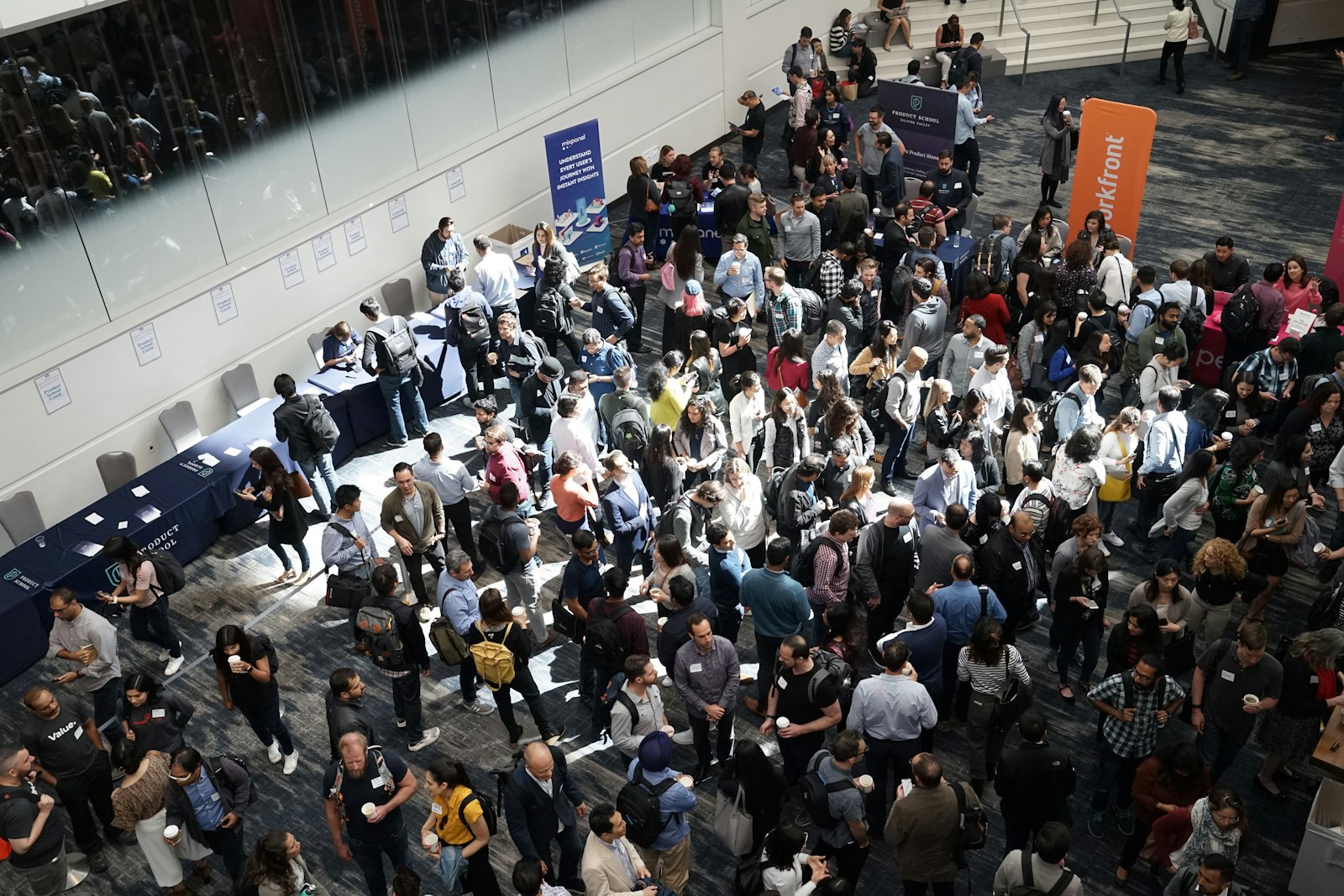
The arrival peak: everybody, all at once, in the same fifteen minutes. Plan lanes for this moment, not for the empty foyer at 2pm. Credit: Product School / Unsplash
Phone-based point of sale: your box office in a pocket
Adding lanes used to mean renting more bulky terminals. It no longer does. Modern door sales run off a phone or tablet that takes contactless payments, which means a "lane" is now a staff member with a device, not a fixed kiosk you paid a day rate for. This is the quiet revolution in on-the-door sales: you can flex from two lanes to five by handing out three more phones, and collapse back down when the rush ends.
The whole market has moved this way. TryBooking, for example, now offers a Box Office app paired with a card terminal that accepts cash, contactless, Apple Pay and Google Pay for in-person sales (TryBooking). The capability to look for is simple: can your platform sell a fresh ticket and take payment on a normal phone, and does that sale immediately count against your capacity? If yes, your box office scales with your staff, not your hardware budget. eventcloud handles door sales and check-in from the same app that runs the rest of your event, so a walk-up bought at the gate and a ticket sold online three weeks ago live in one system.
Keep online and door on one live count
The subtler cause of box office chaos is inventory drift. If your door-sales system and your online sales are two separate ledgers, staff cannot trust the number in front of them, so they slow down to double-check, or worse, they oversell and you spend the evening apologising. A single live capacity count that both online and on-the-door sales draw from removes the hesitation. Every sale, wherever it happens, decrements the same number, so a lane can move at full speed knowing it will not sell the 601st ticket to a 600-capacity room.
This is where the door queue connects to the rest of your operation. Fast walk-up sales, instant ticket or badge issue, and a real-time capacity number are the same underlying feature set that makes check-in fast. Our walk-through of selling walk-ins and same-day tickets at the door goes deeper on the workflow if you want the step-by-step.
When a long queue is genuinely fine
Honesty check: not every queue needs engineering away. A free community event where entry is a quick name-tick does not need five lanes and a payment stack, and a tiny gathering where twelve people might walk up is served perfectly well by one friendly person with a phone. Over-provisioning door lanes for an event that will never see a rush is just staff standing around looking underused. The rule of thumb is to scale your door setup to your realistic walk-up peak, not to build a stadium box office for a village hall.
For everyone else, the fix is refreshingly boring: forecast your walk-up peak, run enough phone-based lanes to clear it, split ticket-holders into their own fast scan line, and keep online and door sales on one live count. Do that and the queue outside your event stops being the first thing your paying guests remember. If you want a single system that sells at the door, scans tickets and tracks live capacity in one place, take a look at what eventcloud does on the day.